
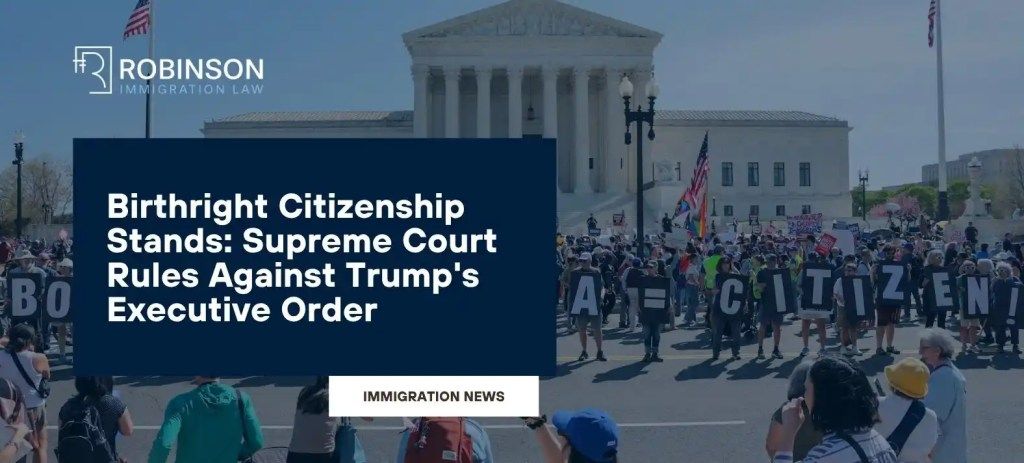
Does where you’re born still determine your citizenship under the U.S. Constitution? On June 30, 2026, the Supreme Court reaffirmed birthright citizenship, ruling that children born on U.S. soil to parents who are undocumented or temporarily present are automatic U.S. citizens under the 14th Amendment. The 6-3 decision in Trump v. Barbara struck down an executive order signed on President Trump’s first day in office in January 2025, which had sought to deny citizenship to certain U.S.-born children. The ruling preserves the citizenship rules that have applied for more than a century and resolves a legal fight that had worked its way through federal courts for over a year.
A Right Rooted in the Constitution: How Birthright Citizenship Became Law
Birthright citizenship in the United States comes from the 14th Amendment to the Constitution, ratified in 1868. The amendment’s Citizenship Clause grants citizenship to nearly all people born in the U.S., regardless of their parents’ nationality or immigration status. Congress adopted the amendment largely to overturn the Supreme Court’s 1857 Dred Scott v. Sandford decision, which had denied citizenship to Black Americans, whether enslaved or free.
Courts have long interpreted the clause under the doctrine of jus soli, or “right of the soil,” meaning citizenship is determined by where a person is born rather than by their parents’ status. The Supreme Court confirmed this interpretation in the 1898 case United States v. Wong Kim Ark, ruling that the 14th Amendment grants citizenship to children born in the U.S. to foreign parents. Under this longstanding framework, only a small number of exceptions apply, such as children born to foreign diplomats.
The Legal Challenge to Birthright Citizenship
The case decided this week grew out of Executive Order 14160, which President Trump signed on January 20, 2025. The order directed federal agencies to stop recognizing citizenship for children born in the U.S. when neither parent was a citizen or lawful permanent resident at the time of birth. It would have applied to children of parents who were undocumented as well as those present on temporary visas.
The administration argued that the phrase “subject to the jurisdiction thereof” in the 14th Amendment had been misapplied for decades. Government attorneys contended that people in the U.S. unlawfully or on temporary status are not fully subject to U.S. jurisdiction because they owe primary allegiance to another country. The order also cited concerns about “birth tourism.”
State attorneys general, immigrant advocacy groups, and expectant parents filed multiple lawsuits shortly after the order was issued. Federal district courts across the country blocked the policy, and after the Supreme Court limited lower courts’ authority to issue nationwide injunctions in a related 2025 case, a class-action challenge proceeded in the U.S. District Court for the District of New Hampshire on behalf of affected children. That case reached the Supreme Court as Trump v. Barbara, named for the case’s lead plaintiff, a Honduran national identified only by her first name.
The Supreme Court’s Decision
The Court affirmed the injunction against the executive order, though the justices split over their reasoning.
The Majority Opinion
Five justices, Chief Justice John Roberts, Sonia Sotomayor, Elena Kagan, Amy Coney Barrett, and Ketanji Brown Jackson, held that the executive order violated the 14th Amendment directly. Writing for the majority, Chief Justice Roberts concluded that the Citizenship Clause’s guarantees extend to children born to parents who are in the U.S. unlawfully or temporarily. He described citizenship as “the right to have rights” and wrote that the Court was upholding a promise made by the amendment’s framers.
Kavanaugh’s Concurrence
Justice Brett Kavanaugh reached the same conclusion by a different path. He wrote that the order violated an existing federal statute, 8 U.S.C. § 1401(a), which traces back to the Immigration and Nationality Act of 1952, rather than the Constitution itself. Kavanaugh’s opinion noted that Congress could, in theory, amend that statute to create new exceptions to birthright citizenship, though it has not done so.
The Dissents
Justices Clarence Thomas, Samuel Alito, and Neil Gorsuch each dissented, though for somewhat different reasons. Thomas, joined by Gorsuch, argued that the 14th Amendment’s guarantee applies only to people “domiciled” in the U.S., and that children of temporary visitors fall outside that guarantee. Alito wrote separately, arguing that citizenship should apply only to children who, at birth, owe allegiance solely to the United States. He called the majority’s decision a serious mistake, while also acknowledging its significance.
What the Ruling Means for Families
So what actually changes for families? In practical terms, nothing. Children born in the United States continue to acquire citizenship automatically at birth, regardless of their parents’ immigration status. Parents who are undocumented, on temporary visas, or awaiting a status adjustment do not need to take any additional steps to establish their U.S.-born children’s citizenship.
Estimates of how many children could have lost automatic citizenship each year under the executive order vary by source and methodology. The Migration Policy Institute and Penn State’s Population Research Institute put the figure at roughly 250,000 annually, while the Center for Immigration Studies estimated a range of about 225,000 to 250,000 births to undocumented parents in 2023. Because the order was enjoined before taking effect, no children were denied citizenship under it.
Looking Ahead
Following the ruling, President Trump suggested on social media that Congress could still act to restrict birthright citizenship through legislation. However, because five justices grounded their decision in the Constitution itself, most legal observers say that changing the outcome would likely require a constitutional amendment rather than an ordinary act of Congress, a considerably higher bar that involves approval from two-thirds of both chambers of Congress and ratification by three-fourths of the states.
Separately, the Department of Justice indicated after the ruling that it plans to prioritize enforcement against “birth tourism,” in which foreign nationals travel to the U.S. specifically to give birth. Estimates of how common this practice is vary, though the Migration Policy Institute has put the figure at roughly 26,000 births per year, a small fraction of the more than 3.5 million births in the U.S. each year.
For now, the ruling leaves the more-than-century-old understanding of birthright citizenship in place, and any future efforts to change it would likely require overcoming significant legal and political challenges.
Need Help Understanding How This Ruling Affects Your Case?
Court decisions like this one can raise new questions about your immigration status. Whether you’re navigating a pending case or planning your next steps, our experienced immigration attorneys can help you understand your options and determine the best path forward.
Request a Free Evaluation today to discuss your situation with the Robinson Immigration Law team.
Because immigration laws, regulations, and court decisions can change, we will continue to monitor developments related to birthright citizenship and provide updates as new information becomes available.
Stay Updated on Birthright Citizenship and Immigration News
The Supreme Court’s ruling may not be the last word on birthright citizenship, with Congress and the DOJ’s “birth tourism” enforcement plans still to come.
For more updates on this case and other immigration policy developments, visit our latest news section to stay informed.